Ming Hwa Yuan Ri Zi Theatre Classic Opera "The Wishing Goddess" 11/1 (Sat) 19:00 at Beitou Qixing Park
- Latest news
- Posted by:Editor
- 2025-10-27 ‧ 1319reads
Introduction to "The Wishing Goddess"
The historical setting of this play is fictionally set during the Liu Song Dynasty, a period rarely explored in theatrical works, yet it was the first dynasty of the Southern Dynasties during the Northern and Southern Dynasties period in Chinese history. An interesting character in the play, "Gu Wan-Fu," connects to the playwright's concept of the "God of Poverty," weaving a futile bargain - three incense sticks to grant three wishes. But this is the God of Poverty, presiding over "poverty, illness, suffering, loneliness, and widowhood" - can these three wishes truly be fulfilled? Fulfilling one brings misfortune to another. What strange events transpire between Gu Wan-Fu and the God of Poverty? "The Wishing Goddess" refuses to view poverty through worldly eyes. There are far too many mysteries in the universe beyond human control, and through layer upon layer of story development, you will come to understand the true rewards between giving and receiving, and between destitution and poverty.
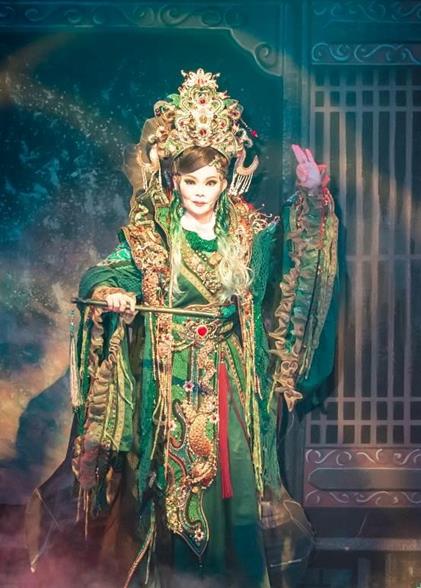 Plot Synopsis:
A chilling atmosphere engulfs Danyang Palace. Emperor Liu Zhun and the Empress flee in panic, looking around like startled birds. The treacherous Xiao Daocheng plots to usurp the Liu Song Dynasty throne. With sword in hand, he kills Liu Zhun and the Empress. In the nick of time, young Princess Bo-Si escapes. To cover up his crimes, Xiao Daocheng orders the Danyang County magistrate Gu Quan to handle the case. Upon arriving at Danyang Palace, Gu Quan finds a horrific scene, but then discovers a chi dragon seal on the ground bearing the name "Emperor Gao of Southern Qi - Xiao Daocheng," leaving him in utter shock. Fifteen years later, new Danyang County magistrate Lu Yun-Fei takes office. The senior clerk and two constables welcome him, but the third constable Gu Wan-Fu arrives late, greatly displeasing Lu Yun-Fei. However, Gu Wan-Fu has good reason - young women in the county have been disappearing one after another, and he is bringing the townspeople to submit a petition to the new magistrate. After Lu Yun-Fei questions them in court, all leads point to the Golden Jade Hall.
The Golden Jade Hall is the grandest department store in Danyang County, owned by the great merchant Qi Ben-Song. The frequent disappearances of young women have also caught Qi Ben-Song's attention. Lu Yun-Fei reveals his identity, and Qi Ben-Song shares his observations. Seeing that this shopkeeper is no villain, Lu Yun-Fei learns from Qi Ben-Song that the clues lead to Cheng-En Temple - a magnificent temple that turns out to be the former Danyang Palace. Are the disappearances connected to the previous dynasty? Meanwhile, constable Gu Wan-Fu, eager to prove his investigative abilities, goes to San-Bei Temple near Cheng-En Temple, only to find it is actually "Three Poverty Temple." Gu Wan-Fu's well-intentioned actions attract the God of Poverty's following. Is this fortune or disaster? And what turning point will the God of Poverty's appearance bring to the disappearances, Gu Wan-Fu's investigation, and the fallen Liu Song Dynasty?